Less waste, fewer emissions, better buildings.
The construction industry is one of the largest contributors to material waste and carbon emissions globally. In Canada, building construction and operations account for roughly 18 percent of national greenhouse gas emissions. Much of that impact comes from the construction process itself — material waste, transportation inefficiencies, and energy consumed on job sites.
Factory-built housing addresses the environmental footprint of construction at the source. By moving production indoors, modular construction can reduce material waste by up to 80 percent, lower transportation emissions through optimized logistics, and produce buildings with tighter envelopes and better energy performance.
How factory conditions reduce waste.
On a conventional construction site, material waste is a fact of life. Lumber is cut to fit and the offcuts are discarded. Drywall is damaged by weather exposure before installation. Packaging materials accumulate. Studies estimate that conventional construction generates 25 to 30 pounds of waste per square foot of building. Factory production cuts this figure dramatically.
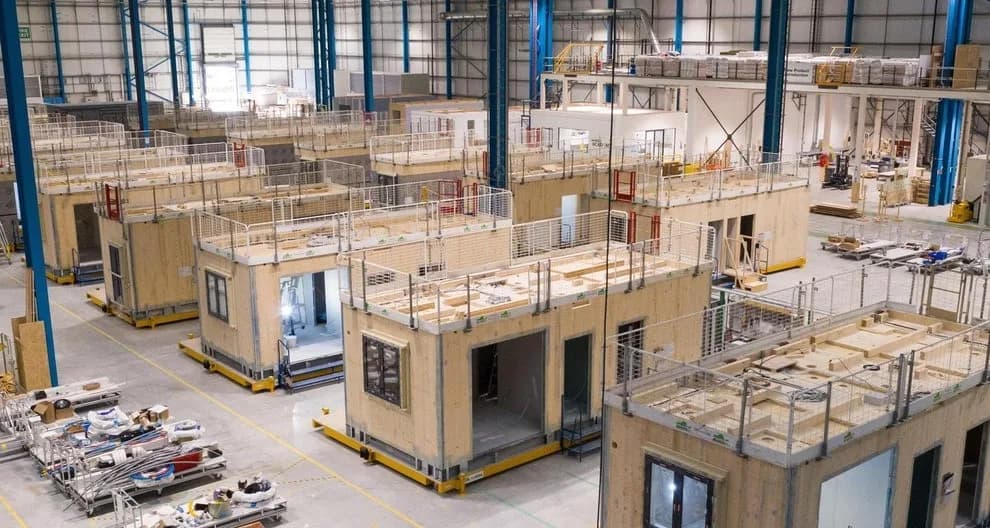
When you build indoors, you control the environment. Materials are stored properly, cut precisely, and used efficiently. The waste bin at the end of the factory line is a fraction of what you see at a conventional job site.
In a factory setting, materials are purchased in bulk, stored in climate-controlled conditions, and cut with precision equipment that minimizes offcuts. Leftover materials from one module can be used in the next. Packaging is consolidated rather than distributed across a sprawling job site. The result is dramatically less waste sent to landfill.
Factory production reduces construction waste by up to 80 percent compared to conventional site building.
Climate-controlled storage prevents material damage from weather exposure before installation.
Precision cutting equipment minimizes offcuts and enables material reuse across modules.
Tighter building envelopes produced in factory conditions improve energy performance over the building's lifetime.
Consolidated logistics reduce the number of truck trips and associated transportation emissions.
The lifetime performance advantage.
The environmental case for factory-built housing extends beyond the construction phase. Modules built in controlled factory conditions tend to have tighter building envelopes — fewer air leaks, more consistent insulation, and better-sealed windows and doors. This translates into lower energy consumption for heating and cooling over the building's entire lifespan.
For a province like Quebec, where winter heating represents a significant portion of residential energy use, the long-term energy savings of a well-sealed modular building can be substantial. Better performance during construction is valuable, but better performance over 50 years of occupancy is where the real environmental impact accumulates.